
Property Defects • Structural Issues • Buyer Guide
Finding structural issues during a house purchase can feel alarming. A report mentioning cracks, movement, or structural concerns is enough to make many buyers consider pulling out entirely — sometimes unnecessarily.
This guide explains what structural issues actually mean, how serious different types typically are, and what happens when a survey flags them. Not all structural problems are the same, and understanding the difference matters before you make any decisions.
Important context: Not all structural issues are urgent or serious. Many older properties show signs of historic movement that is stable and not progressing. A survey report that notes structural concerns is giving you information — it is not necessarily telling you to walk away.
In this guide
What are structural issues in a house?
A structural issue refers to any problem affecting the load-bearing or stability elements of a property — the parts of the building that hold it up and hold it together. This includes the foundations, load-bearing walls, roof structure, floors, lintels, and the overall frame of the building.
Structural issues are distinct from cosmetic defects (cracked plaster, peeling paint) or maintenance issues (a leaking gutter, worn sealant). A structural problem typically involves movement, deterioration, or failure in an element that supports the building’s integrity.
The term covers a wide range of situations — from historic movement that is now stable, to active subsidence that is ongoing and potentially serious. The word “structural” alone does not tell you how serious a problem is. Context matters enormously.
Signs of structural problems: what to look for
Some signs of structural issues are visible during a viewing, though not all are easy to interpret without experience. A RICS surveyor assesses these with trained eyes and specific knowledge of building construction.
Cracks in walls
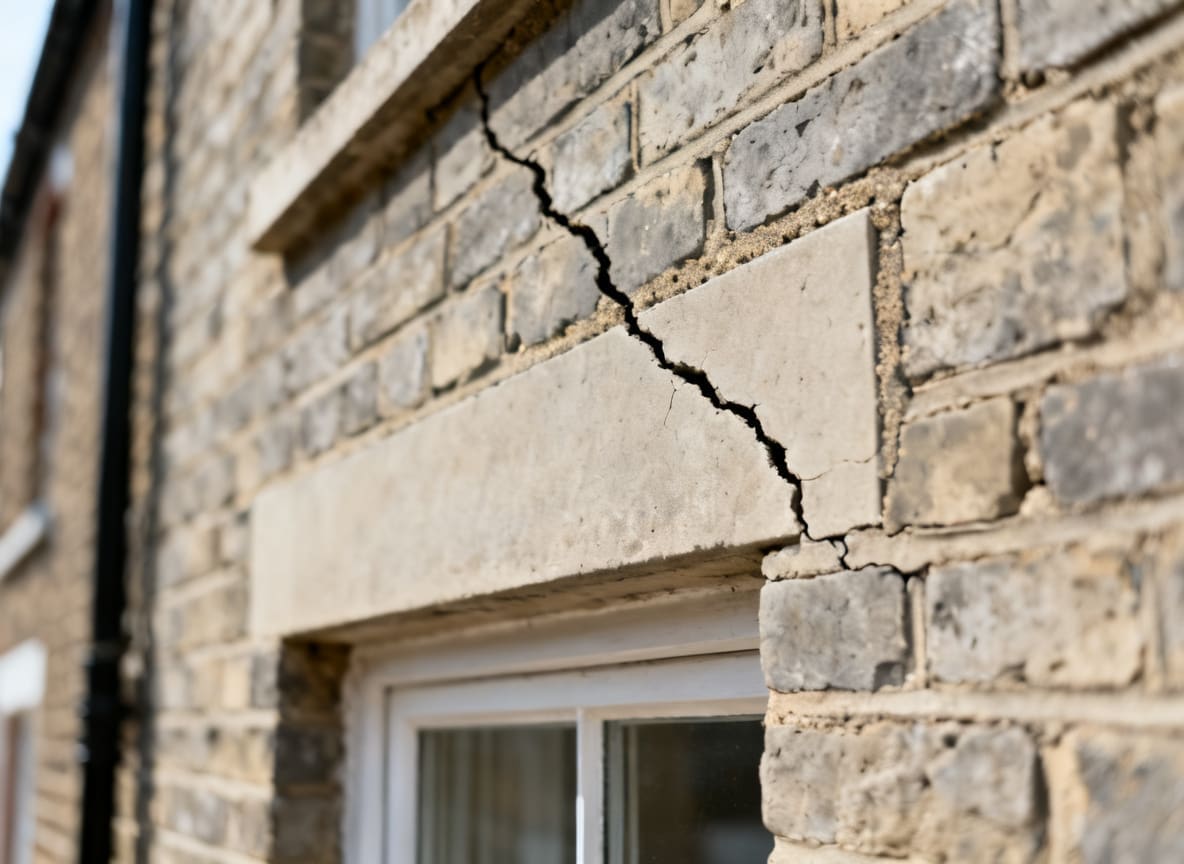
Cracks are one of the most commonly noticed signs and one of the most frequently misunderstood. Not all cracks are serious. Hairline cracks in plaster are normal as buildings settle and expand with temperature and humidity. Wider cracks — particularly those that follow a diagonal pattern, appear at the corners of windows and doors, or are visible on external walls — may indicate structural movement.
The width, direction, and pattern of a crack help determine its significance. A tapered crack (wider at one end) suggests differential movement. A crack running through masonry joints is different from one running through the bricks themselves. These details matter, and a surveyor is trained to distinguish between them.
Doors and windows that stick or fail to open properly
When a building moves, door and window frames distort. Doors that stick, do not close flush, or show gaps where they did not before may indicate movement in the surrounding wall or frame. This is often an early indicator — more noticeable in older properties where the building has had time to react to ground or structural changes.
Sloping or uneven floors
Some floor slope is expected in older properties — it does not always indicate a current problem. Significant unevenness, or floors that have changed perceptibly over a short period, may indicate movement in the floor joists, beams, or the ground beneath.
Visible bowing or leaning in walls
A wall that bulges outward, leans noticeably, or appears to be separating from an adjacent wall is a more immediate concern. This type of visible deformation may indicate structural failure in ties, lintels, or the wall itself.
Gaps between walls, floors, and ceilings
Gaps appearing along skirting boards, between walls and ceilings, or around chimney breasts may indicate movement in the building. As with cracks, the key question is whether the movement is historic and stable, or recent and active.
Common causes of structural issues
Understanding what causes structural problems helps put them in context. Many have identifiable root causes — some more straightforward to address than others.
Subsidence
Subsidence occurs when the ground beneath a property moves downward, taking the foundations with it. It is one of the most serious structural issues a property can have, partly because of the cost and complexity of remediation, and partly because of its implications for insurance.
Common causes include clay soil shrinkage during dry weather, roots from nearby trees drawing moisture from the soil, leaking drains undermining the ground, and historic mining activity in certain areas.
Foundation failure
Older properties — particularly Victorian and Edwardian buildings — were often built on shallow foundations by modern standards. Where the ground or loading conditions change, these foundations may struggle to perform adequately, resulting in movement over time.
Lintel failure
Lintels are the structural beams above windows and door openings that carry the load of the wall above. Older steel lintels can corrode; older timber lintels can rot. When a lintel fails or is undersized, cracking typically appears around the opening and can spread into the surrounding masonry.
Wall tie failure
Cavity wall construction relies on metal ties to bind the inner and outer leaves of the wall together. In properties built before the 1980s, these ties were often mild steel and are now susceptible to corrosion. When they fail, the outer leaf of the wall can separate and bow outward — a serious structural concern requiring specialist investigation and repair.
Settlement
Settlement — different from subsidence — refers to the gradual compaction of ground under the weight of a building over time. Most settlement in established properties is historic and stable. It may leave a building out of square or with minor slopes, but does not mean the building is in danger.
How serious are structural issues?
The severity of a structural issue depends on several factors: whether the movement is active or historic, what is causing it, how much it has progressed, and what repair would involve.
| Type of issue | Likely seriousness | Typical next step |
|---|---|---|
| Hairline cracks in plaster | Usually cosmetic | Monitor; no action typically needed |
| Diagonal cracks at window/door corners | Minor to moderate; worth investigating | Surveyor assessment; possibly structural engineer |
| Historic movement, now stable | Often low risk if not progressing | Monitor; note in report; may affect insurance |
| Active subsidence | Serious; needs specialist attention | Structural engineer report; drainage investigation |
| Bowing or bulging external wall | Potentially serious; wall tie failure possible | Specialist investigation required |
| Lintel failure above opening | Moderate to serious depending on extent | Specialist assessment; repair or replacement |
No table can cover every situation. What matters is getting an accurate assessment of the specific issue in the specific property — which is what a survey is designed to provide.
What a house survey can tell you about structural problems
A RICS survey — particularly a Level 3 building survey — is well-placed to identify signs of structural issues and assess their significance. The surveyor will examine the property systematically, looking specifically for evidence of movement, cracking, distortion, and deterioration in structural elements.
Where structural concerns are identified, the Level 3 report will:
- Describe what the surveyor found and where
- Suggest what may be causing it
- Indicate how significant it appears to be based on visible evidence
- Recommend further action — specialist investigation, structural engineer’s report, or simply monitoring
It is important to understand that a visual survey — even at Level 3 — cannot definitively diagnose all structural issues. Some problems are concealed behind finishes or beneath floors. Where the surveyor suspects something but cannot fully assess it from a visual inspection, they will flag it as a limitation and recommend specialist follow-up.
A specific defect report can be commissioned to focus on a single structural concern in more detail — useful where a general survey has identified something that needs closer analysis.
Level 2 vs Level 3 for structural concerns: If you are buying a property with visible cracks or other signs of structural issues, a Level 3 building survey is generally the better choice over a Level 2. It provides a more thorough assessment of the building’s structure and more detailed commentary on anything the surveyor finds.
What to do if a survey flags structural issues
Receiving a report that mentions structural concerns can feel unsettling. The first step is to read the report carefully and understand what specifically has been flagged, and how the surveyor has described its significance.
Read the summary section first
Most survey reports include a summary or key issues section. This is the place to start. If structural matters are mentioned, this section will typically indicate whether the surveyor considers them urgent, worth investigating, or simply worth noting.
Ask your surveyor for clarification
If anything is unclear, contact your surveyor. You should be able to discuss findings directly and get a plain-English explanation of what they mean in practical terms. A good surveyor will help you understand the difference between a serious active problem and a historic, stable issue that is common in properties of that type and age.
Commission further specialist investigation where recommended
If the surveyor recommends a structural engineer’s report or specialist investigation, take that seriously. The surveyor is not saying the building is unsafe — they are saying there is something they could not fully assess from a visual inspection, and that a specialist would give you a clearer picture before you proceed.
Use the report to renegotiate if appropriate
Where structural issues are identified that have a clear repair cost, buyers sometimes use the survey findings to renegotiate the purchase price. A documented survey report provides evidence that both parties can refer to. This is one of the practical reasons surveys are valuable beyond just peace of mind.
Make a decision with the full picture
Structural issues do not automatically mean a property is a bad purchase. Older buildings in particular often have a history of movement, repair, and adaptation. The question is whether you understand what you are taking on — and whether the price reflects it. A thorough survey gives you the information you need to make that call.
Concerned about structural issues in a property you are buying?
LM Surveyors carries out Level 2 and Level 3 surveys across Lincolnshire, Nottinghamshire, and surrounding areas. Our RICS-qualified surveyors provide clear, evidence-led reports — no jargon, no guesswork — so you can make informed decisions before you exchange.
Get in touch with our team — or call 01522 438989.
Frequently asked questions
Should I pull out of a purchase if a survey finds structural issues?
Not necessarily. The decision depends on what has been found, how serious it is, whether the movement is active or historic, and whether the price reflects the condition. A surveyor can help you understand what the findings mean in context. Many properties with noted structural history are bought and sold without issue.
What is the difference between subsidence and settlement?
Settlement is the gradual compaction of ground under a building over time — it is common in established properties and is usually stable. Subsidence involves the ground moving downward more significantly, typically due to an identifiable cause such as clay shrinkage, tree roots, or drainage failure. Subsidence may be ongoing and typically requires specialist investigation and potentially remediation.
Will structural issues affect my mortgage or insurance?
They may. Mortgage lenders sometimes have requirements relating to structural condition, and insurers may ask about subsidence or structural work history when you apply for buildings insurance. It is worth discussing any survey findings with your mortgage broker and insurer before exchange.
Do I need a structural engineer as well as a surveyor?
A RICS surveyor provides an assessment of condition and will flag concerns where they are identified. If they recommend further specialist investigation, a structural engineer may be the appropriate specialist for structural concerns specifically. Your surveyor will indicate in their report when this is the recommended next step.
Can a Level 2 survey identify structural issues?
A Level 2 survey can identify visible signs of structural issues and flag them for attention. However, a Level 3 building survey provides a more detailed assessment of structural elements and more thorough commentary on the causes and implications of anything found. For properties where structural issues are a concern, a Level 3 is generally the more appropriate choice.
Lyman Marshall Chartered Surveyors is a RICS regulated, RPSA-accredited practice based in Lincoln, serving buyers and homeowners across Lincolnshire, Nottinghamshire, and surrounding areas. Visit our property buyer guides for more information.
Related reading: Signs of a Poorly Built House: What Buyers Should Know.


