

Reviewed and signed off by Lyman Marshall Surveyors, Director, Surveyor and RICS Registered Valuer at Lyman Marshall Chartered Surveyors. Published 15 October 2026 · Updated 15 October 2026
There is one defect that announces itself in a pattern so regular you could measure it with a tape. Cavity wall tie failure produces horizontal cracks that repeat up a wall at almost identical intervals — roughly every 450mm, which on standard brickwork is about every sixth mortar course.
Buyers walk past it constantly, because a thin horizontal line in a mortar joint looks like nothing at all. Surveyors stop at it, because the regularity is the giveaway. Buildings do not crack in neat repeating rows by accident.
Quick answer: Cavity wall tie failure happens when the metal ties joining the inner and outer leaves of a cavity wall corrode and expand. The expansion lifts the brickwork, producing repeating horizontal cracks at regular vertical intervals, bulging walls and lifted roof edges. It is a structural defect and needs specialist assessment.
What a wall tie actually does
A cavity wall is two separate walls with a gap between them. The outer leaf keeps the weather out; the inner leaf carries load and holds up the floors and roof. On their own, neither is stable enough. The ties are what make the two leaves act as one.
Remove them and the outer leaf becomes a tall, thin, unrestrained piece of masonry. That is the risk in a nutshell: not that the wall cracks, but that it eventually stops being held to anything.
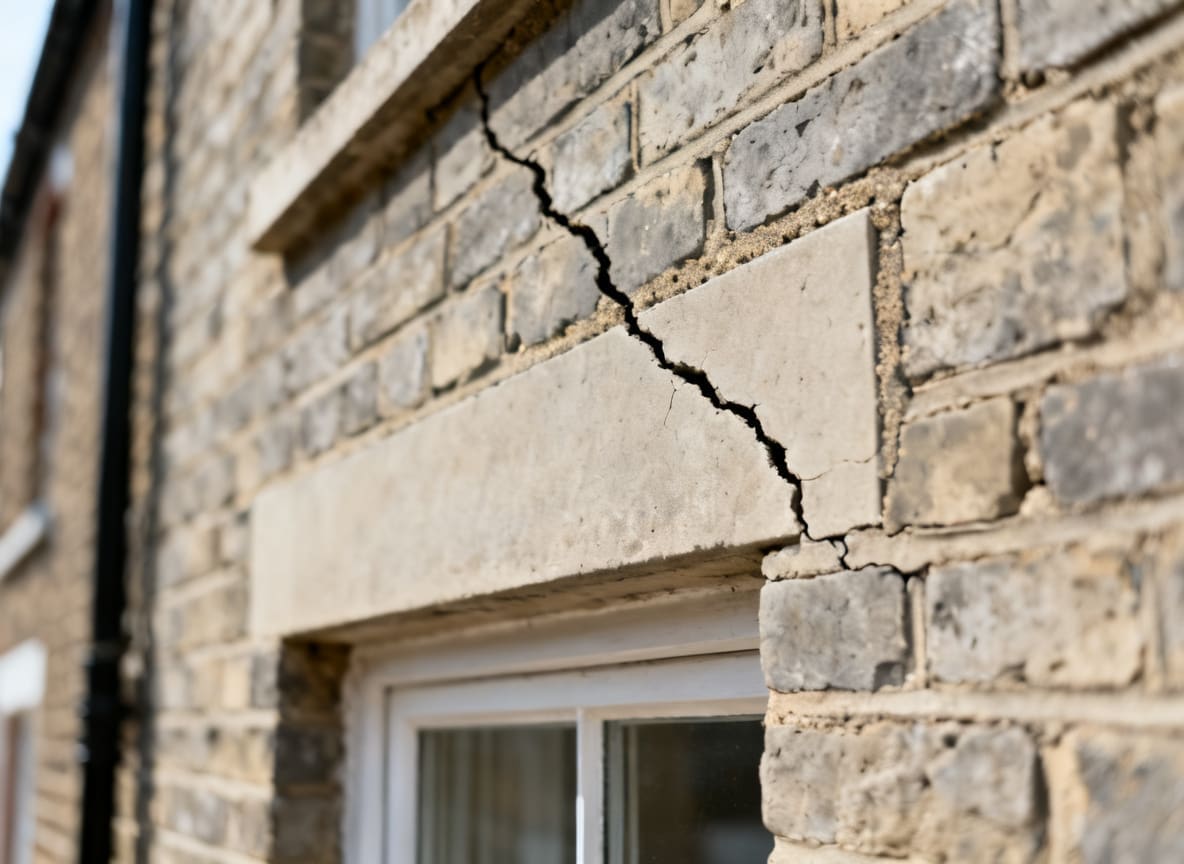
Why the cracking is so regular
The pattern comes straight from the way the wall was built. Under the Building Regulations guidance for structure, wall ties in a cavity wall should be spaced at 900mm horizontally and 450mm vertically, or otherwise arranged to give at least 2.5 ties per square metre.
So the ties sit on a grid. When they corrode, they all corrode at broadly the same rate, in the same wall, in the same weather. Rust occupies more volume than the steel it came from, so each tie quietly jacks the bed joint it sits in.
Multiply that by a grid of ties and you get a wall lifting in horizontal bands at the tie spacing. The 450mm vertical figure is why the cracks land around every sixth course of standard brickwork, and why the defect is recognisable long before anyone opens the wall up.
The five things a surveyor looks for
- Repeating horizontal cracking in the mortar beds at consistent vertical intervals, usually most obvious on the wall taking the worst of the weather.
- Bulging or bowing of the outer leaf, best seen by sighting along the wall from one corner rather than looking at it face on.
- A lifted roof edge or verge, or a gable that appears to have grown — cumulative expansion up a tall wall has to go somewhere.
- Stepped cracking at corners where the expanding wall meets a return that is not moving with it.
- Displaced or cracked window and door heads, and gaps opening at the junction between frames and masonry.
None of these is conclusive alone. Together, and with the spacing measured, they form a strong case.

How it differs from other cracking
This is the part worth getting right, because the remedy and the cost are entirely different depending on the answer.
| What you see | Typical of wall tie failure | Typical of other causes |
|---|---|---|
| Crack direction | Horizontal, following mortar beds | Diagonal or stepped, crossing bricks and joints |
| Pattern | Repeats at regular vertical spacing | Usually a single crack, or cracks radiating from one point |
| Widest point | Roughly even along its length | Often tapered, widest at top or bottom |
| Where it appears | Exposed elevations, often the whole wall | Near openings, extensions, drains or trees |
| Wall shape | Outer leaf bulges outwards | Wall stays flat, but may lean or drop |
Diagonal and stepped cracking points somewhere else entirely — foundations, ground conditions or thermal movement. We look at how those are assessed in our guide to whether cracks are always structural, and at the wider picture in our piece on the signs of movement in houses.
A common misreading: a horizontal crack is often dismissed as “just the render” or blamed on a failed lintel. Render does crack, and lintels do fail — but neither produces a repeating pattern up an entire elevation at even spacing.
Which walls are most at risk
Age and exposure do most of the work. Cavity walls built before the early 1980s were commonly tied with galvanised mild steel. The zinc coating protects the steel until it is used up; after that, the steel is on its own inside a damp cavity.
Exposure decides how quickly that happens. In our experience across Lincolnshire and Nottinghamshire, the south-westerly elevation — the one that takes the driven rain — is very often where the pattern shows first, sometimes years ahead of the other three walls of the same house.
Coastal and open fen locations accelerate it further. So do walls that were built with mortar snots left on the ties, or with the ties sloping the wrong way, both of which carry water across the cavity to exactly the wrong place.
Confirming it, and what the repair involves
Visual inspection raises the suspicion. Confirming it means a borescope inspection: small holes drilled into the mortar so the condition of the ties can be seen and graded inside the cavity. Guidance for assessing corroded ties and deciding on action has long been set out in the Building Research Establishment’s digest on replacing wall ties.
Remedial work does not usually mean rebuilding. New stainless steel ties are installed through the existing masonry on a designed grid, and the old ties are isolated or removed so they cannot continue to expand. Cracked joints are then repointed, or damaged brickwork cut out and replaced.
Costs depend entirely on the number of elevations affected, access, scaffolding and how much brickwork needs making good. It is not a repair to price from a blog post — get a specialist to quote against a proper report.
What it means if you are buying
Wall tie failure is fixable, well understood, and carried out routinely by specialist contractors. What it is not is something to leave unresolved through a purchase, because a lender’s valuer who spots it will very reasonably want it investigated before releasing funds.
If you are already committed to a purchase and this is the only concern, a specific defect report focuses an inspection on that one issue and tells you what is happening and what it will take to put right. Where the wall is one worry among several, a fuller inspection is the better route — our explanation of what a RICS Level 3 Building Survey includes sets out the scope.
Either way, the useful move is the same: establish what is actually going on before you negotiate. A price conversation backed by a report lands very differently from one backed by a worry.
After the work: the paperwork matters as much as the ties
Once remedial ties are in, the job is only half finished from a property point of view. What makes the repair count on a future sale is the record of it: the specification the contractor worked to, a plan showing where the new ties went, the number installed, and an insurance-backed guarantee.
We see the consequences of the alternative fairly regularly. A wall has clearly been retied — the resin plugs are visible in the joints if you know what you are looking at — but nobody can produce a single sheet of paper about it. The next buyer’s surveyor then has to report an unverified repair, and the next lender treats it accordingly.
If you are selling and the work was done years ago, it is worth chasing the contractor for a duplicate certificate before the property goes on the market. If you are buying and the seller says it has been done, ask for the documents at the same time you ask for the boiler service history. It is a two-minute question that saves a fortnight later.
Does this affect newer houses?
Far less often, and for a straightforward reason: stainless steel ties became the norm in cavity wall construction, and stainless steel does not corrode in the way galvanised mild steel does. A house built in the last few decades is very unlikely to be showing tie corrosion.
Newer walls can still show horizontal cracking for other reasons — thermal movement, a missing movement joint on a long run of brickwork, or a poorly bedded lintel. Those look superficially similar and are far less costly to resolve, which is exactly why identifying the cause correctly is worth doing before anyone panics about the price.
Seen cracking you cannot explain?
If a wall is cracking in a pattern that bothers you, we can inspect it and tell you what is causing it. We carry out specific defect reports and full building surveys across Lincoln, Lincolnshire, Nottinghamshire and the surrounding counties.
How serious is cavity wall tie failure?
It is a genuine structural defect, because the ties are what keep the outer leaf restrained. It is rarely an emergency, but it does not improve on its own and it will affect a lender’s view of the property. It is repairable by specialist contractors.
How long do cavity wall ties last?
It depends on what they are made of and how exposed the wall is. Galvanised mild steel ties, common in older cavity walls, have a finite life because the protective coating is eventually consumed. Modern stainless steel ties are far more durable.
Does wall tie failure affect a mortgage?
It can. A valuer who identifies it will typically recommend further investigation, and a lender may hold back funds until the position is clarified or the work is done. Resolving it with a report and a specialist quote is usually straightforward.
How do you check wall ties without demolishing the wall?
With a metal detector to locate the ties and a borescope inspection through small drilled holes, so their condition can be seen and graded within the cavity. The holes are made good afterwards and the process is not destructive.
Can I see wall tie failure from inside the house?
Usually not. The corroding ties sit in the cavity and it is the outer leaf that moves, so the evidence is almost always external. That is one reason it is so easy for buyers to miss on a viewing.


